Call Simone on 020 8952 0404·WhatsApp 07966 285266·simone@verywellhung.co.uk
Office blinds · Screen glare

The sun is on the screens and nobody can work.

What actually fixes screen glare, and what only looks like it does.

It starts at about three o’clock on the west side, it is worse in March than in June, and half the office has already turned their monitors to face the wall. Here is what causes it, how to tell which kind you have, and which blind and fabric fix it without turning a daylit floor into a basement.

Free, no obligation. Photograph the window, add your postcode, and Simone will tell you what she would specify and roughly what it involves.

Roughly what it costs

Office blinds from around £150 per window, supplied and fitted.

As a guide, standard office roller blinds typically fall around £150 to £300 per window. Larger windows, specialist fabrics and motorisation cost more.

The exact price is confirmed after the free site survey, priced around the actual specification rather than a per-window estimate.

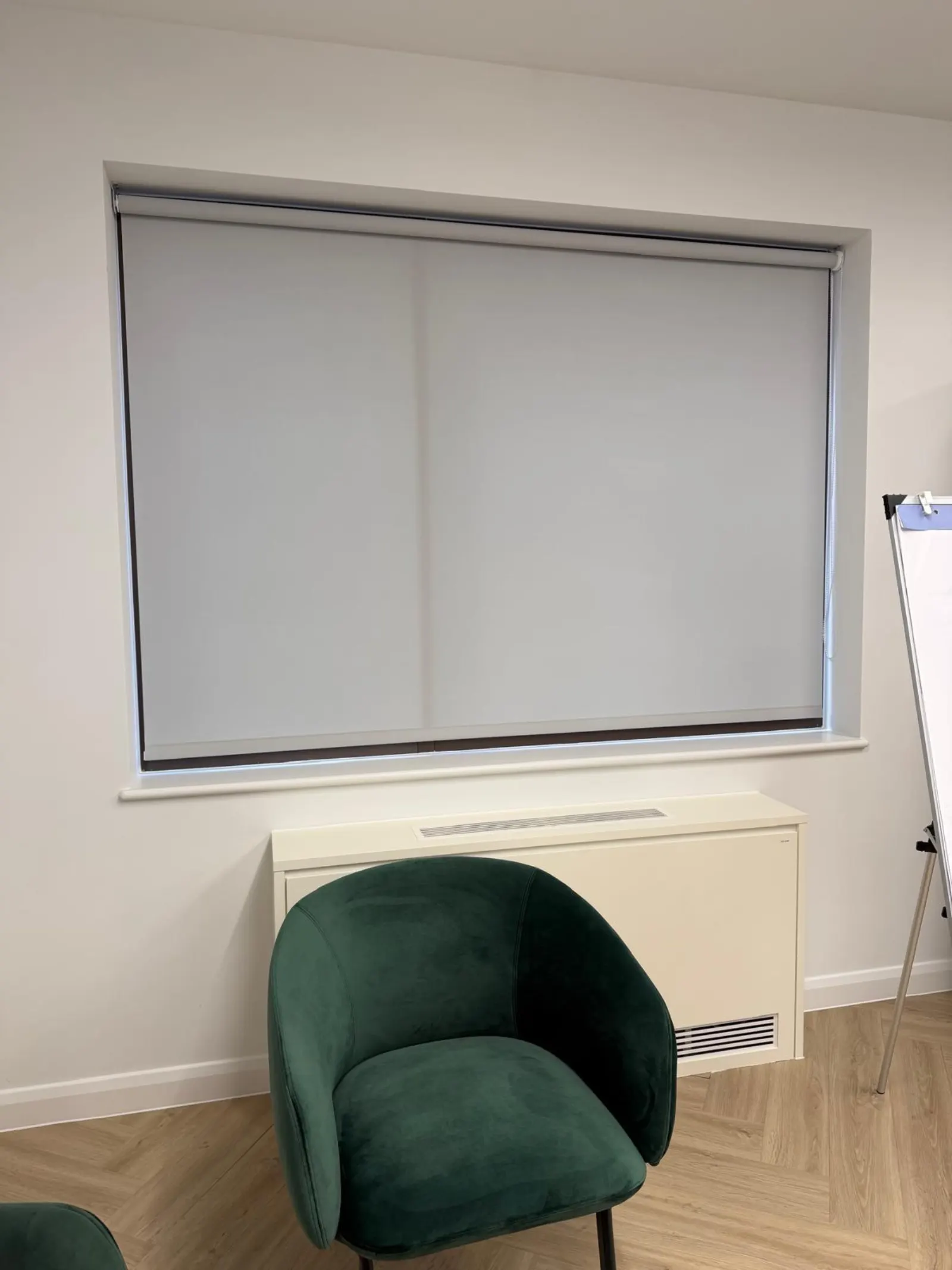
Roller blind in a solar screen fabric fitted at an office window
From around £150Per window, supplied and fitted
Free site surveyNo obligation to proceed
Specified, not soldRecommendation before quote
Owner-led serviceOne point of contact
London & HertfordshireBased in North-West London
Quick answers

The short version, before the detail.

Which blinds are best for screen glare?

A roller blind in a solar screen fabric, in almost every case. Screen fabric is woven to a stated openness factor, roughly 1% to 10%, which is the proportion of the weave left open. Lower cuts more glare and gives more privacy, and lets you see out less. Blackout fabric also fixes the screens, and puts the overhead lights on at eleven in the morning, which is why it is the wrong answer to this particular problem.

Should the fabric be dark or light?

Dark, if you want to keep the view. This surprises almost everyone. A darker screen fabric gives better outward visibility and better glare control, because the eye reads through the weave rather than at it. A pale fabric rejects more solar heat, but in direct sun it becomes a bright surface of its own, which is its own glare source in a room full of monitors.

Do we have to do the whole floor?

Usually not. Glare is an aspect problem before it is a building problem. East and west elevations are the worst and only for an hour or two at each end of the day. A north elevation often needs nothing at all. Specifying the elevations that actually suffer costs less than doing the building, and looks better than three different blinds on one face.

Diagnosis

How to tell what you are actually dealing with

Glare gets reported as "the sun is a nightmare", which is not enough to specify against. These six tell you which kind you have, and most of them are visible from the doorway.

Monitors have been turned away from the window

The most reliable sign there is, and the one nobody ever reports. People solve glare themselves by rotating the screen, which fixes the reflection and leaves them sitting at an angle to their desk, the room and whoever they are talking to. If a row of monitors is out of square with the desks beneath them, the window is the reason.

The blinds are down and the lights are on

At eleven in the morning, in a room with a wall of glass. Somebody specified a blackout or dim-out fabric for a glare problem. It works. It also costs the floor its daylight and the business its lighting bill, which is a trade nobody consciously agreed to.

It is only bad for an hour, twice a day

Low sun on an east or west elevation, arriving at screen height at the beginning and end of the working day. This is the sharpest kind of glare and, oddly, the most straightforward to fix, because the fabric only has to do its work at a low sun angle.

It moves across the floor through the day

A south elevation. Higher in the sky, longer in duration, and affecting a different set of desks at ten than at three. It is usually a heat problem as well as a light problem, and that narrows the fabric choice, because the same blind is being asked to do two jobs.

It is worst on video calls

A different problem with the same cause. The camera exposes for the bright window behind the person and turns them into a silhouette. It is solved by controlling the light behind the head rather than the light on the screen, which is why a room can be perfectly comfortable to work in and impossible to be seen in.

The screen looks washed out rather than reflective

Veiling glare: light falling across the face of the monitor and lifting the blacks, rather than a mirror image of the window sitting in it. It reduces contrast on everything at once, and people usually describe it as the screen looking dirty rather than as a glare problem at all.

Background

Why it happens

Glare is contrast, not brightness

A monitor becomes unreadable when the light around it or falling on it overwhelms the image, not when the room is bright. A well daylit office with the sun under control is a more comfortable place to look at a screen than a dim one with a single blazing window in it.

That is why making the room darker is so often the wrong instinct: it lowers the brightness and leaves the contrast exactly where it was.

Low sun is the worst offender

Sun low in the sky arrives at desk and screen height and travels a long way into the room. That is a morning problem on an east elevation and an afternoon one on a west. It is also worse in the months either side of midwinter than at the height of summer, which is the opposite of what most people expect and the reason glare complaints often arrive in February.

Reflected light counts as sun

A glass building opposite, a pale render wall, a parked car, a wet car park in low sun. Reflection puts sun on an elevation that should not get any, at times of day that make no sense from the aspect alone. It is the usual explanation for a north-facing room with a glare problem nobody can account for.

It is a duty, not just an irritation

Employers have to assess display screen equipment workstations, and lighting, reflections and glare on the screen are part of what that assessment covers. The HSE sets out what is involved in working safely with display screen equipment. A room where people have quietly turned their monitors away from the window has already failed that assessment in practice, whatever the paperwork says.

What to do about it

What actually fixes it, cheapest first

The first two cost nothing. Any specifier who does not raise them before quoting is selling rather than advising.

1

Move the desk, or turn the monitor

Free, and worth trying before anyone quotes for anything. Screens are best placed at right angles to a window rather than facing it or backing on to it. In a small room with one window that is sometimes the entire answer, and it takes ten minutes.

2

Use what is already there, properly

Existing vertical blinds that nobody adjusts are a very common finding. Louvres angled towards the sun rather than closed flat will control a surprising amount of glare while keeping the daylight, and the cost of that is a conversation rather than an order. Where the existing blinds are the right product badly used, saying so is the honest answer.

3

A solar screen roller blind

The usual answer, and the one that solves the problem without taking the daylight with it. One moving part, a minimal stack at the head, and the widest fabric choice of any system. The decision that matters is not the blind, it is the fabric that goes on it.

Industry guidance on blind systems and their installation is published by the British Blind and Shutter Association, the national trade association for the blind and shutter industry.

4

Choosing the openness factor

Roughly 1% to 10%, the proportion of the weave left open. A 3% fabric cuts glare hard and keeps a usable outward view. A 10% fabric keeps more daylight and more view, and does correspondingly less work. On a low-sun elevation, lower is usually right. Where the view is the reason the business took the office, it is a genuine trade to talk through rather than a number to pick off a chart.

Openness is one of several figures published under BS EN 14501, the standard that classifies blinds and shutters for thermal and visual comfort, which is what lets one fabric be compared with another rather than simply described.

5

Two fabrics on one window

A dual roller carries a screen fabric and a dim-out on the same bracket, so a room can be daylit and glare-free for most of the week and properly dark when it needs to be. It costs more than either fabric alone and less than fitting two separate blinds, and it earns its place in a room that is both a workspace and a presentation space.

6

Motorisation on high or wide glazing

Worth considering where blinds are beyond hand reach, or where a whole elevation ought to move together rather than in the order people get round to it. A blind nobody can reach is a blind that stays wherever it was last left, which in practice means down. This is a real step up in cost and is not the answer to a glare problem at desk height.

How the recommendation is arrived at

Every office is different, so the survey comes first.

Most office blind quotes are a price list run against a window schedule. A survey is a different exercise: it establishes what each room is for, what it actually suffers from and what would fix it, which fairly often costs less than the obvious answer. The project can then be quoted around the real specification rather than a generic per-window estimate.

Send a photo instead
What the survey establishes
  • Which way each elevation faces, and the hours each room is genuinely occupied
  • Where people sit relative to the glass, and who has their back to it on video calls
  • What is opposite the window: glass, pale render or standing water that could be reflecting sun onto an elevation the aspect says should be fine
  • Whether the room overheats as well, because the same fabric cannot be optimised for both
  • What is outside, because a view worth keeping changes the openness factor
  • Whether the existing blinds are the right product being used badly
Where Very Well Hung works

Office blinds across London and Hertfordshire

Very Well Hung is based in North-West London and works with businesses across London and Hertfordshire. For larger commercial projects, enquiries from further afield are also welcome.

Areas regularly covered, including
  • Edgware
  • Stanmore
  • Mill Hill
  • Borehamwood
  • Barnet
  • Hendon
  • Finchley
  • Harrow
  • Bushey
  • Radlett
  • Watford
  • St Albans
  • Hertford
  • Potters Bar

This list is not exhaustive. Commercial projects elsewhere across London and Hertfordshire are welcome.

Questions businesses ask

Screen glare, answered properly.

Which blinds are best for computer screen glare?

A roller blind in a solar screen fabric, in almost every case. Screen fabrics are woven to a stated openness factor, roughly 1% to 10%, and cut glare while keeping the room daylit and, at the right openness, keeping the view out.

The lower the number, the more glare control and privacy you get and the less you can see through it. Which figure suits a particular room depends on the aspect, the hours it is used and what is outside the window.

Will screen blinds make the office dark?

No, and that is the point of them. A screen fabric is a woven fabric with a stated proportion of the weave left open, so daylight continues to come through it while the direct sun is cut.

That is the difference between a screen fabric and a dim-out, and it is why specifying a dim-out for a glare problem is the mistake worth avoiding: it solves the screens and then the overhead lights go on at eleven in the morning.

Should we just get blackout blinds instead?

Only if the room genuinely needs to be dark for another reason, such as projection. Blackout will certainly stop the glare, and it will also stop the daylight, put the lights on and make the room an unpleasant place to sit for eight hours. For a glare problem specifically it is the most expensive way to create a second problem.

What openness factor do we need?

There is no single right answer, which is why it is worth a conversation rather than a default. As a rule of thumb, 1% to 3% for hard glare control and daytime privacy, 5% as the common middle, and 10% where daylight and view matter more than the last of the glare.

Low sun on an east or west elevation pushes you lower; a view the business is paying for pushes you higher.

Do dark or light fabrics work better for glare?

Darker, if outward visibility matters. It surprises most people. A dark fabric absorbs rather than scatters the light hitting it, so the eye reads through the weave instead of at it, giving both better glare control and a clearer view out.

Pale fabrics reflect more solar heat back out, which is an advantage on an elevation that also overheats, but in direct sun a pale blind becomes a bright surface of its own in a room full of monitors.

Will blinds fix glare on video calls?

Usually, though it is a slightly different job. On a call the problem is normally the bright window behind the person rather than sun on their screen: the camera exposes for the window and turns the face into a silhouette.

What fixes it is bringing the brightness of the background down to something closer to the face, which a screen fabric does well. It is worth identifying which desks face which way before specifying, because the seat that needs it is not always the one complaining.

Do we have to do every window?

Almost never. Glare is an aspect problem: east and west elevations suffer at each end of the day, south moves across the floorplate, and north often needs nothing at all.

Doing the elevations that actually suffer costs less and looks better than a building carrying three different blinds on the same face. Where a run is client-facing, matching across the whole run matters more than the glare does, and that is worth deciding room by room.

Is glare on a screen the employer’s responsibility?

Assessing it is. Employers have to carry out display screen equipment workstation assessments, and lighting, reflections and glare on the screen form part of what those assessments cover.

That does not prescribe blinds, or any particular product, and this is not legal advice. It does mean that a room where people have turned their monitors away from the window is a room with a finding waiting to be written down.

Do you cover Edgware, Stanmore and Mill Hill?

Yes. Very Well Hung is based in North-West London and those are part of the area Simone covers regularly, along with Hendon, Finchley, Barnet and Harrow. Send a photo of the window with your postcode and she can tell you what she would specify before anyone visits.

Do you cover Watford, Borehamwood and Hertfordshire?

Yes. Borehamwood, Bushey, Radlett and Watford are all part of the regular area, and the list is not exhaustive. For larger office projects, enquiries from further afield across London and Hertfordshire are welcome.

The next step

Send Simone a photo of the window.

Free, no obligation. Photograph the window, add your postcode, and Simone will tell you what she would specify and roughly what it involves.

Prefer not to use WhatsApp? Call 020 8952 0404, email simone@verywellhung.co.uk, or use the office survey form.

Free survey · from around £150 a window, fitted

Send a photo Call Simone
Web Design & Development by Automika