Call Simone on 020 8952 0404·WhatsApp 07966 285266·simone@verywellhung.co.uk
Office blinds · Overheating

The south side of the office is unbearable by two o’clock.

What a blind can do about solar gain, and what it honestly cannot.

The air conditioning runs flat out and still loses, one side of the floor is uncomfortable while the other is fine, and somebody has brought in a fan. Here is what solar gain actually is, what an internal blind can and cannot do about it, and where a solar-reflective fabric is worth fitting rather than fitting everywhere.

Free, no obligation. Photograph the window, add your postcode, and Simone will tell you what she would specify and roughly what it involves.

Roughly what it costs

Office blinds from around £150 per window, supplied and fitted.

As a guide, standard office roller blinds typically fall around £150 to £300 per window. Larger windows, specialist fabrics and motorisation cost more.

The exact price is confirmed after the free site survey, priced around the actual specification rather than a per-window estimate.

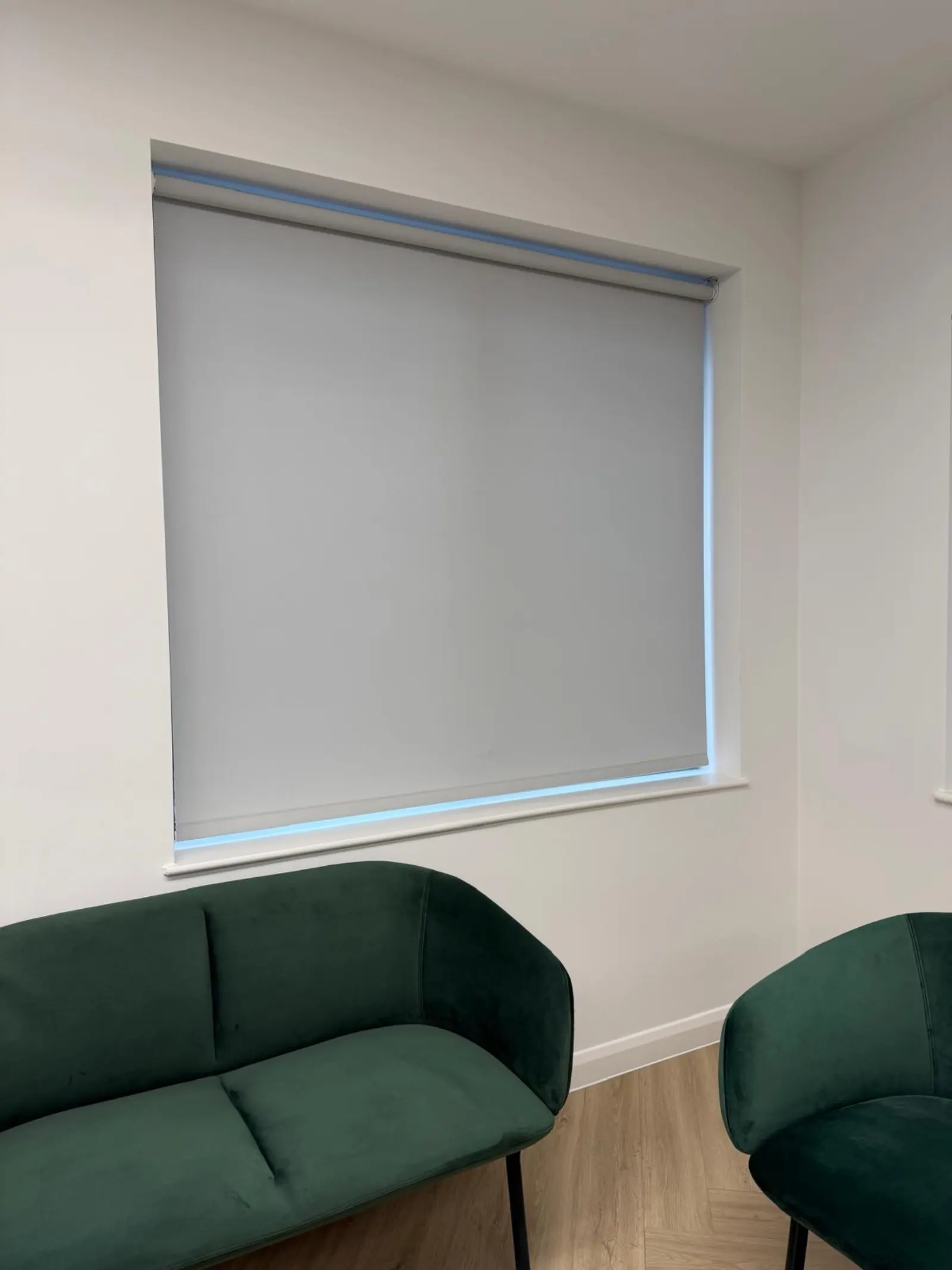
Roller blinds fitted across an office elevation to control solar gain
From around £150Per window, supplied and fitted
Free site surveyNo obligation to proceed
Specified, not soldRecommendation before quote
Owner-led serviceOne point of contact
London & HertfordshireBased in North-West London
Quick answers

The short version, before the detail.

Will blinds actually cool the office down?

They will cut the heat coming in, but an internal blind cannot match external shading. By the time the sun reaches the fabric it is already through the glass and inside the room. What a solar-reflective fabric does is bounce a meaningful share of it back out before the room absorbs it. Manufacturers publish that figure for the glass and blind together rather than for the fabric on its own, which is the number worth asking for.

Is there a legal maximum office temperature?

No. There is no legal maximum working temperature in the UK. There is a duty to keep the temperature at a comfortable level, and a suggested minimum of 16C for most indoor work. The HSE is explicit that no maximum exists because every workplace is different. Worth knowing before anyone quotes you on the basis that there is a number to hit.

Do we need it on every window?

Almost never. Overheating is usually one or two elevations, and often one or two rooms on them. Putting the reflective fabric where it earns its place costs a fraction of doing the floor, and looks considerably better than a building wearing three different blinds on the same face.

Diagnosis

How to tell it is solar gain

Plenty of things make an office too warm. These are the signs that point at the glazing rather than at the air conditioning, the occupancy or the plant.

It peaks in the afternoon, not at the hottest part of the day

A west elevation takes the sun late, and the building holds it. If the worst hour is between two and five rather than tracking the outside temperature, the sun on the glass is doing it rather than the weather.

One side of the floor is uncomfortable and the other is fine

The single clearest indicator. Air temperature equalises across an open floorplate reasonably well; solar gain does not, because it lands where the sun lands. A five-degree difference between two ends of the same room is a glazing problem, not a plant problem.

The air conditioning runs constantly and still loses

Cooling plant is sized for a heat load. When the load through the glass exceeds what it was sized for, it runs continuously at full output and holds the room at a temperature nobody is happy with, while costing more every hour it does it.

The glass and the sill are warm to touch

Worth doing with the back of a hand on a sunny afternoon. Warm glass and a warm sill mean energy is arriving and being absorbed by the room fabric, which then re-radiates it for hours after the sun has moved off the elevation.

It is bad in spring and autumn too

Solar gain is about the angle of the sun as much as the temperature outside. A low March sun reaches deep into a room through south glazing on a day when the outside air is cold, which is why a room can overheat on a day nobody would describe as hot. If that pattern is familiar, it is the sun.

Somebody has propped a door open or bought a fan

People fix their own environment before they report it, exactly as they do with glare. A desk fan on the sunny side of an air-conditioned office is a complaint that has already been made and answered privately.

Background

Why it happens

Glass is very good at letting energy in

Solar gain through glazing is the largest summer heat load in most London offices. Glass admits short-wave solar energy easily; the room absorbs it, warms up, and re-radiates it as long-wave heat that the same glass is much worse at letting back out. That asymmetry is the whole mechanism, and it is why a glazed room heats up faster than it cools down.

The air conditioning is fighting it at your cost

Cooling does not remove the cause, it removes the consequence, every hour, for as long as the sun is on the elevation. Reducing the gain at the glass reduces the work the plant has to do, which is the part that shows up on a bill rather than on a thermometer.

Where a blind sits in the order of things

External shading is the most effective, because it stops the energy before it reaches the glass at all. The glazing itself comes next: a modern coated unit rejects far more than old clear glass. An internal blind is third, and it is third for a real reason. It is also, for most tenants in most buildings, the only one of the three they are actually able to change.

What the regulations cover, and what they do not

Limiting solar gains is part of the energy guidance for new and refurbished buildings, which for offices sits in Approved Document L, Volume 2, buildings other than dwellings.

That is a design-stage matter for the building, not something that applies to fitting blinds in an office you already occupy. On workplace temperature itself the position is simpler than most people assume: the HSE confirms there is no legal maximum working temperature, only a duty to keep it at a comfortable level.

What to do about it

What can be done, cheapest first

The honest order runs from free to expensive, and the most effective option on the list is the one Very Well Hung does not supply.

1

Use the blinds you have, when the sun is on that elevation

Closing an existing blind on the sunny side for the two or three hours the sun is actually on it does more than most people expect, and it costs nothing. It is worth ruling out before spending anything, and worth knowing that it is often not done because nobody has ever been told which elevation matters and when.

2

Solar-reflective screen fabric, on the elevations that overheat

The core of the answer. A screen fabric with a reflective backing rejects a substantial share of the solar energy back out through the glass before the room can absorb it, while still letting daylight through and, at the right openness, keeping the view. Fitted on the one or two elevations that actually suffer, rather than across a whole floor.

3

Asking for the right number

The figure that matters is the total solar energy rejected by the glass and blind together, not a claim about the fabric alone.

Fabric manufacturers publish it for common glazing types under BS EN 14501, the standard that classifies blinds and shutters for thermal and visual comfort, and it is measured rather than asserted, so it can be compared between quotes. A supplier who cannot produce a figure for your glazing is describing a fabric, not specifying a solution.

4

The appearance trade nobody mentions

The reflective backing has to face the glass to work, so from outside the building that elevation reads as a uniform pale band whenever the blinds are down. On a single tenanted floor of a multi-tenant building that can matter to a landlord, and it is much easier to raise before the order than after the installation.

5

Solar control film

Worth knowing about honestly. Film is applied to the glass, is usually cheaper than blinds, and works permanently, which is both its advantage and its problem: it also works in December, when the room would rather have the sun.

It gives no control at all and cannot be adjusted by the person sitting there. Where a room overheats every month of the year and nobody wants to operate anything, it is a reasonable answer, and it is not a blind.

6

External shading, which outperforms all of it

Brise soleil, external louvres or an awning stop the energy before it reaches the glass and beat any internal blind comfortably. This is a building-level decision, usually the landlord’s rather than the tenant’s, and it is not what Very Well Hung supplies. It belongs on this list because it is true, and because a specifier who leaves it off the list is not giving you the full picture.

How the recommendation is arrived at

Every office is different, so the survey comes first.

Most office blind quotes are a price list run against a window schedule. A survey is a different exercise: it establishes what each room is for, what it actually suffers from and what would fix it, which fairly often costs less than the obvious answer. The project can then be quoted around the real specification rather than a generic per-window estimate.

Send a photo instead
What the survey establishes
  • Which elevations overheat, and at which hours of which months
  • Whether the air conditioning is genuinely struggling or simply running expensively
  • Whether the glazing is already coated or tinted, which changes what a blind still needs to do
  • Whether the same windows also cause screen glare, because one fabric cannot be optimised for both
  • How the building reads from outside, if the landlord cares about uniformity across an elevation
  • Whether anything in the lease or fit-out specification constrains what can go on the glass
Where Very Well Hung works

Office blinds across London and Hertfordshire

Very Well Hung is based in North-West London and works with businesses across London and Hertfordshire. For larger commercial projects, enquiries from further afield are also welcome.

Areas regularly covered, including
  • Edgware
  • Stanmore
  • Mill Hill
  • Borehamwood
  • Barnet
  • Hendon
  • Finchley
  • Harrow
  • Bushey
  • Radlett
  • Watford
  • St Albans
  • Hertford
  • Potters Bar

This list is not exhaustive. Commercial projects elsewhere across London and Hertfordshire are welcome.

Questions businesses ask

Overheating, answered properly.

Do blinds actually reduce heat in an office?

Yes, with a caveat worth being straight about. An internal blind cannot match external shading, because by the time the energy reaches the fabric it is already through the glass and inside the room. What a solar-reflective fabric does is reject a meaningful share of it back out before the room absorbs it.

The figures are published for the glass and blind combination, so the effect can be compared rather than argued about. In practice it is worth specifying on the one or two elevations that genuinely overheat rather than across a whole floor.

Is there a maximum legal temperature for an office?

No. There is no legal maximum working temperature in the UK. Employers have a duty to keep the temperature at a comfortable level and to provide clean, fresh air, and there is a suggested minimum of 16C for most indoor work, or 13C where the work involves rigorous physical effort.

The HSE is explicit that no maximum figure exists because every workplace is different. This is not legal advice, but it is worth knowing before anyone quotes on the basis of a number.

Which blind fabric is best for solar heat?

A screen fabric with a reflective backing, in a lighter tone. Pale and metallised backings reflect more solar energy back out through the glass than dark ones absorb, which is the opposite of the rule for glare control, and it is why a window that both overheats and causes screen glare is a genuine specification decision rather than an obvious one. The reflective face has to point at the glass to work.

Is film better than blinds for solar control?

It depends entirely on whether you want control. Film is applied to the glass, usually costs less, and works permanently. That is its advantage in a room that overheats all year, and its drawback in December, when the room would rather have the sun and there is no way to change your mind.

Blinds cost more and can be opened. Neither is universally right, and any supplier who only sells one of them will tell you theirs is.

Will solar blinds make the office dark?

No. A screen fabric leaves a stated proportion of the weave open, so daylight continues through it while the direct solar energy is cut. The lighter reflective fabrics used for heat control keep a room notably brighter than a dim-out would. What they do less well is preserve a crisp view out, because a pale weave scatters light rather than letting the eye read straight through it.

Does the whole elevation have to be done at once?

Not necessarily, though this is the one case where doing a partial run often shows. A single elevation seen from outside with three windows blinded and five not is conspicuous in a way that a back office is not. Where the elevation is visible from the street or from a shared courtyard, it is usually worth doing the run together even when only some rooms suffer.

Will blinds reduce our air conditioning costs?

They reduce the heat load the plant has to deal with, which is the input to that cost rather than the cost itself. How much that saves depends on the plant, the tariff, how the building is controlled and how the space is occupied, so anyone quoting you a percentage saving from a blind alone is guessing.

The reliable statement is narrower and still useful: less solar energy entering the room means less work for the cooling, for as long as the sun is on that elevation.

The landlord controls the facade. Does that change anything?

Often, yes, and it is worth checking early rather than late. Many leases and fit-out specifications say something about what may be fitted to or seen through the glazing, precisely because a facade with mismatched window coverings behind it is a value question for the building owner.

It rarely stops a project. It does sometimes decide the fabric colour, and it is much easier to establish at survey than after an order has been placed.

Do you cover Edgware, Stanmore and Mill Hill?

Yes. Very Well Hung is based in North-West London and covers those regularly, along with Hendon, Finchley, Barnet and Harrow. Send a photo of the window with your postcode and Simone can tell you what she would specify before anyone visits.

Do you cover Watford, Borehamwood and Hertfordshire?

Yes. Borehamwood, Bushey, Radlett and Watford are all part of the regular area, and the list is not exhaustive. For larger office projects, enquiries from further afield across London and Hertfordshire are welcome.

The next step

Send Simone a photo of the window.

Free, no obligation. Photograph the window, add your postcode, and Simone will tell you what she would specify and roughly what it involves.

Prefer not to use WhatsApp? Call 020 8952 0404, email simone@verywellhung.co.uk, or use the office survey form.

Free survey · from around £150 a window, fitted

Send a photo Call Simone
Web Design & Development by Automika