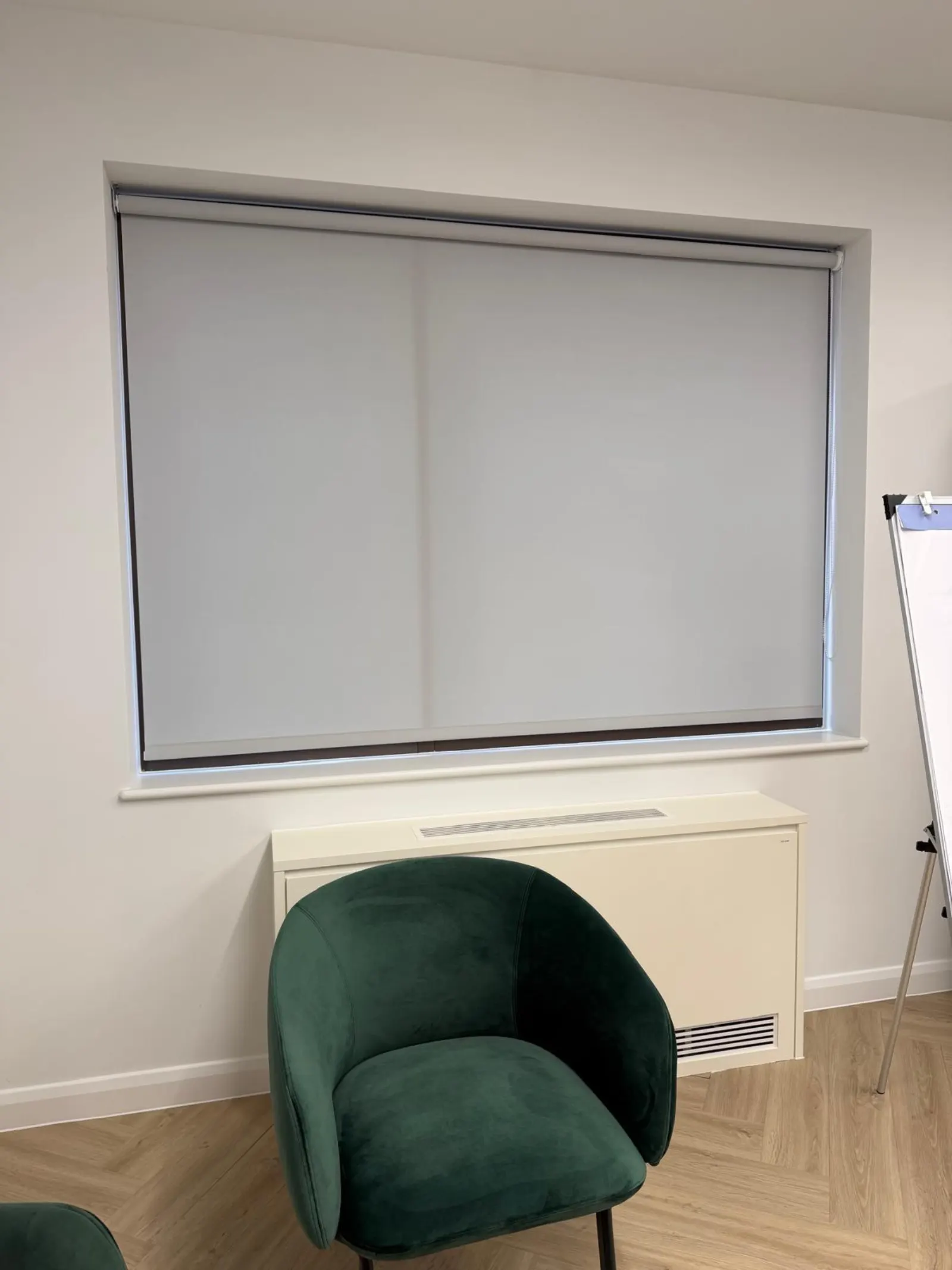
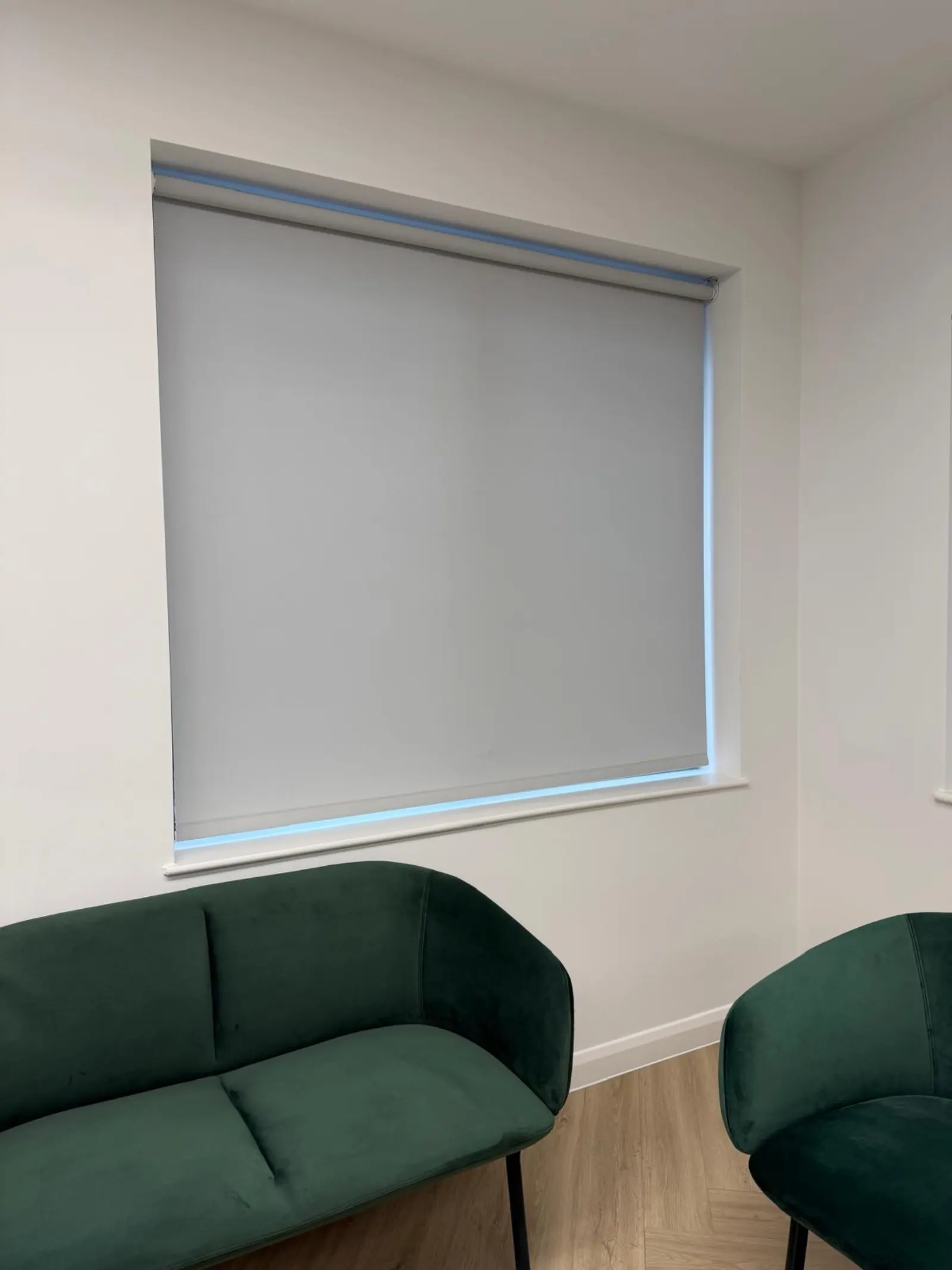
How much do office blinds cost?
As a guide, around £150 to £300 per window for standard office roller blinds, supplied and professionally fitted. The exact price is confirmed after the free site survey. Larger windows, specialist fabrics and motorisation cost more, and the drivers below are predictable enough to tell you where the money goes before anyone quotes.
Quantity and size do most of the work. A forty-window office is not forty times a one-window job, because survey and installation time are shared, but fabric and mechanism scale directly with area.
After that comes the fabric, which runs from plain dim-out polyester at one end to specialist contract cloth at the other, and costs more again in wider widths, because of how it is woven and cut. Then the mechanism: a chain-operated spring roller, a cassette, side channels and motorisation are each a real step up in cost.
Then anything non-standard in the fitting: top-fixing into concrete, wide runs split into linked blinds, angled or arched openings that need templating. And finally access, which is the one people forget. An atrium that needs a tower, or an installation that has to work around a building’s sign-in and lift booking, costs more than the same blind at desk height on a Tuesday morning.
Following the survey, the project can be quoted around the actual specification rather than a generic per-window estimate.
Do you provide free office surveys?
Yes, free and without obligation. Simone visits the workplace, looks at the windows and how each room is used, and gives a recommendation. You get the recommendation whether or not you go ahead with the quote.
Which blinds are best for reducing screen glare?
Usually a roller blind in a solar screen fabric, not a blackout one. Screen fabrics cut glare and solar heat while keeping the room daylit and, at the right openness factor, keeping the outward view. Openness is stated as a percentage, roughly 1% to 10%, and the lower the number, the more glare control and privacy you get, and the less you see through it.
Darker fabrics give better outward visibility and better glare control than pale ones, which surprises most people. Which is right for a particular room depends on the aspect, the hours it is used and what is outside the window.
Can office blinds reduce heat?
Yes, though an internal blind cannot match external shading. By the time the energy reaches the fabric it is already through the glass. What a solar-reflective fabric does is reject a meaningful share of it back out before the room absorbs it, and manufacturers publish the figures for the glass-and-blind combination.
In practice it is worth specifying on the one or two elevations that actually overheat, rather than across a whole floor.
Does the whole office have to be done at once?
Not necessarily. If an office already has blinds in place, their condition can be assessed during the survey. Whether any existing components are worth retaining depends on their condition and whether they are compatible with the new specification.
Matching a fabric across an existing run is the harder problem, because dye lots shift and UV has already moved the old blinds, so it is worth deciding room by room which runs need to match and which do not.
What blinds are best for a conference room or boardroom?
The same answer as a meeting room: a dim-out roller on a slimline cassette, in most cases. Conference room, meeting room and boardroom describe the same problem in different words, and the specification follows the glass rather than the name on the door.
Privacy is intermittent, so the blind has to open again easily; if the room presents to a screen, dim-out matters more than blackout; and if the room is glass-partitioned rather than external, the head detail and the door swing decide more than the fabric does. Where the run is wide, as boardroom glazing usually is, a vertical blind frequently suits it better than a single oversized roller.
How is installation handled in an occupied office?
It is planned around the working day, and agreed before anything is scheduled. If the office is occupied, access and installation requirements are discussed before the work is scheduled, so disruption can be kept practical for the business. Buildings with sign-in procedures, permits or shared goods lifts are worth flagging at survey rather than at quote, because they affect the schedule more often than they affect the specification.
What about very large or high office windows?
They are worth surveying rather than assuming they are impossible. Wide openings are generally handled as linked blinds sharing a bracket line, with the joins set on the mullions so the run reads as one. A single oversized tube deflects, and the fabric tracks off.
For glazing beyond hand reach, how the blinds would actually be operated day to day becomes part of the specification, and so does the access needed to install them.
What about fire-rated fabrics for commercial premises?
Commercial projects may require fabrics meeting specific fire-performance standards. In the UK, textiles for non-domestic curtains and blinds are commonly specified against BS 5867-2, the British Standard covering their flammability requirements, with different types covering different levels of requirement.
If your landlord, insurer or fit-out specification sets a standard, it is worth raising at the survey rather than afterwards: it narrows the fabric range, and discovering it once the blinds are up means buying them twice. Bring the requirement to the survey and it can be established what is needed before anything is specified.
How long does it take from survey to installation?
It depends on the fabric and on building access, and it is confirmed with the quotation. Lead time varies according to the chosen blind system, fabric, quantity and installation requirements, and timescales are confirmed as part of the quotation.
The usual variables are the fabric, where stock ranges move quickly and cut-to-order or specialist contract cloths do not, and access arrangements in a managed building, which can add more than the manufacturing does.
We are fitting out a new office. When should we think about blinds?
Earlier than most people do. Window coverings are usually the last trade on site and the one most often forgotten until the handover date is fixed. Looking at them while the partitions are still drawings avoids the two problems that cost time later: head details with nowhere to fix, and blind positions that fight the door swings.
Which areas do you cover?
London and Hertfordshire, from a base in North-West London. Very Well Hung is based in North-West London and works with businesses across London and Hertfordshire: Edgware, Stanmore, Mill Hill, Borehamwood, Barnet, Hendon, Finchley, Harrow, Bushey, Radlett, Watford, St Albans, Hertford and Potters Bar among them, and that list is not exhaustive. For larger commercial projects, enquiries from further afield are welcome.