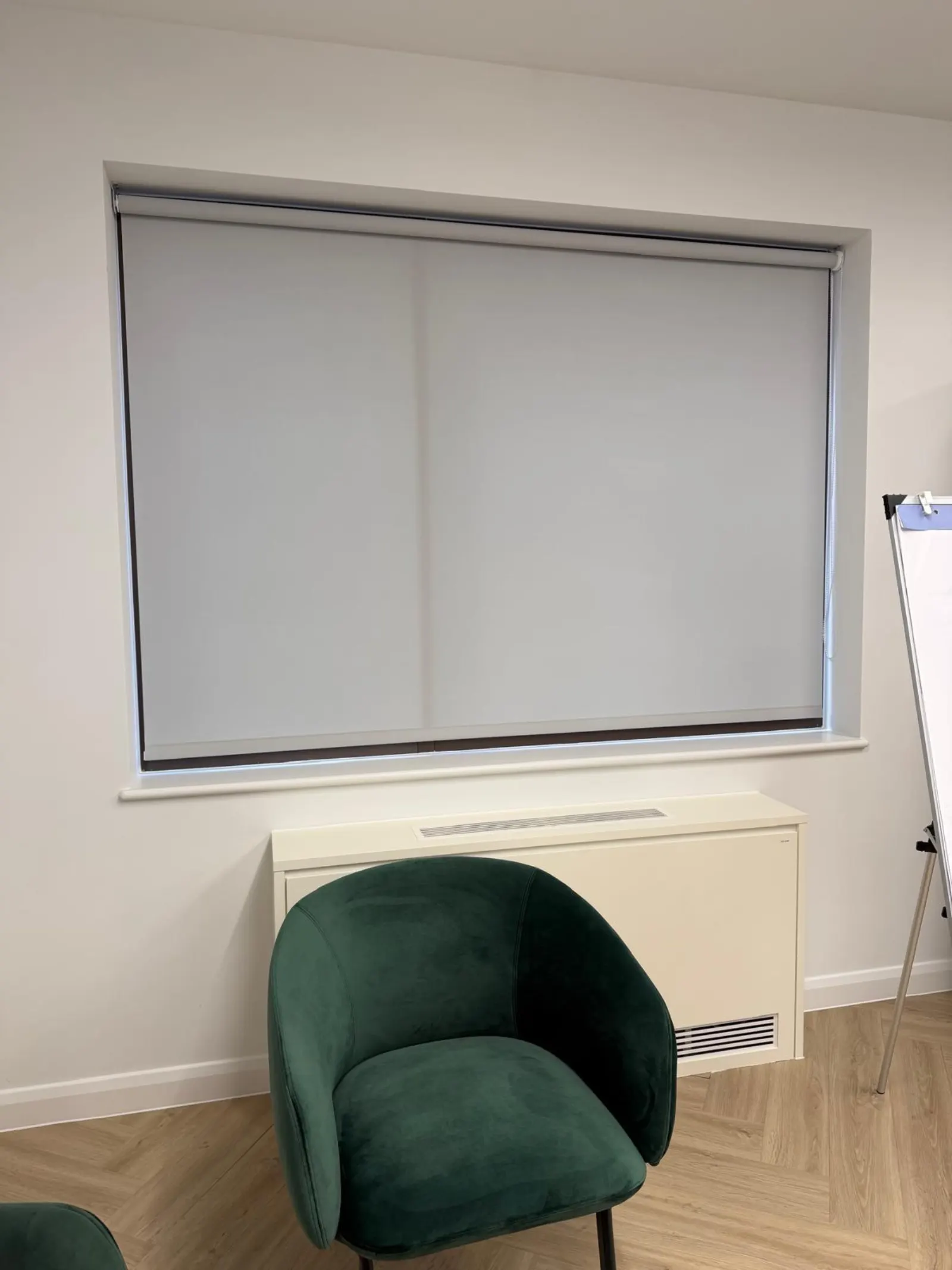
What blinds are best for glass meeting rooms?
A dim-out roller on a slimline cassette suits most internal partitions. Workplace privacy is almost always intermittent: the room needs to be open and visible for most of the week and closed for an hour, so what matters is that it is quick and repeatable to operate rather than permanently opaque.
On a wide run a vertical blind often works better, because it gives graduated control and can be replaced a slat at a time.
Is frosted film better than blinds for a meeting room?
Only where the privacy is genuinely permanent. Film solves the one hour a week and compromises the other thirty-nine, and a glass-walled room is usually glass-walled on purpose, to borrow daylight into the middle of a floorplate and keep the space feeling open.
For a consulting room or an HR office that should never be seen into, film is a sound and cheaper answer. For a meeting room that is normally open, it is the wrong tool.
Can we have privacy and still keep the daylight?
During the day, yes. A light-toned screen fabric obscures the room while it is brighter outside the glass than inside it, so the room stays bright and the view in is broken up.
The important caveat is that it reverses after dark: once the room is the lit side, it becomes more visible than it was. In a London winter that happens well before the end of the working day, so it depends entirely on when the room is used.
Do blinds help with meeting rooms being overheard?
Barely, and it is worth saying plainly. Fabric absorbs a little reflected sound inside the room and does almost nothing about transmission through a glass partition, around its edges or under the door.
If the real complaint is that conversations carry, the answer is in the partition, the seals and the door rather than in anything fitted to the glass. Anyone selling you a blind as an acoustic solution is overselling it.
What about privacy on a street-facing ground floor?
A different problem from an internal partition, and usually a more serious one. Passers-by can see in whenever it is brighter inside than out, which through a London winter is most of the working day. A dim-out roller solves it completely and takes the daylight with it.
A light screen fabric keeps the room bright and gives daytime obscurity, but reverses after dark, which matters if the room is used in the evening or if there is equipment on show.
Will a blind satisfy the requirement for markings on glass partitions?
No, and it is worth separating the two. Large glazed screens and doors generally need manifestation, the markings that make the glass visible so people do not walk into it, and the relevant guidance sits in Approved Document K.
A blind is not manifestation, because a blind that is normally open leaves the glass exactly as it was. This is not a compliance service Very Well Hung provides, and it is worth checking the markings on their own account rather than assuming a new blind has covered it.
How quickly can the blinds be closed when a meeting starts?
The operating method matters more than the fabric on a meeting room. A chain-operated roller on a two-metre partition takes a few seconds. A wide run of verticals takes longer and involves walking the length of it. If a room is booked back to back and needs to switch state between meetings, that difference is the specification.
Can the blinds match across several meeting rooms?
Within one order, yes, and that is the moment to do it. The same fabric from the same supplier shifts between dye lots, so rooms specified a year apart can be visibly different even with an identical fabric name on the paperwork.
Where several rooms front a client-facing corridor, ordering the run together is worth more than it costs. In back-of-house rooms it usually does not show and does not matter.
Do you cover Edgware, Stanmore and Mill Hill?
Yes. Very Well Hung is based in North-West London and covers those regularly, along with Hendon, Finchley, Barnet and Harrow. Send a photo of the partition with your postcode and Simone can tell you what she would specify before anyone visits.
Do you cover Watford, Borehamwood and Hertfordshire?
Yes. Borehamwood, Bushey, Radlett and Watford are all part of the regular area, and the list is not exhaustive. For larger office projects, enquiries from further afield across London and Hertfordshire are welcome.